Presentation and summary of the Urban Thinkers Campus: “Reinventing Housing” in Guise on March 5, 2025
Updated: May 9
By the Executive Board of AdP - Villes en Développement
Presentation of the Urban Thinkers Campus: “Reinventing Housing”
The choice of the Familistère de Guise was no coincidence. Built in the 19th century by the visionary industrialist Jean-Baptiste André Godin, the Familistère was much more than a collection of workers' dwellings. A veritable “social palace,” it foreshadowed a form of integrated collective housing that combined dwellings, community facilities, and spaces for culture, education, and leisure, based on a philosophy of solidarity, proximity, and dignity. An avant-garde model, inspired by Fourierist ideals, it continues to fuel current thinking on sustainable and inclusive housing. In many respects, this model better meets the expectations of the Sustainable Development Goals (SDGs), particularly SDG 11, than most current housing production solutions.
The campus has joined this movement by offering an immersive day centered around four themes:
1. Exploring the Familistère as a housing model that already met current development requirements in the 19th century, including those of the SDGs as defined in 2015.
2. Current architectural and social innovations for the housing of the future;
3. Convergences and divergences in approaches to collective housing around the world;
4. The co-construction of a vision for sustainable and collaborative housing.

A structured day rich in exchanges
The day began in Paris with the OECD teams setting off by bus, joined in Guise by representatives from AdP, the Sorbonne Institute for Development Studies (IEDES), Sciences Po Rennes, Aire Nouvelle-EQUANS, and other partners from France and elsewhere (even America!). Upon arrival, participants were welcomed in the foyer of the Familistère theater with a welcome coffee.
The opening session, held in the solemn setting of the theater, laid the foundations for reflection. Bruno Airaud, general coordinator of the Familistère, recalled the historical significance of the site and the fact that it is a living space for experimentation and reflection on housing and the solidarity economy.
Christine Auclair presented the campus's objectives in the context of a systemic and multidimensional crisis—societal, political, and environmental—calling for a collective rethinking of forms of housing. Indeed, urban sprawl makes cities more energy-intensive, fragments natural spaces, increases dependence on cars, increases public costs, and reinforces social inequalities. It also weakens urban cohesion and resilience to crises. Thus, there are many lessons to be learned from the Familistère experience in order to rethink the proximity and management of neighborhoods. We will add to this the experiences of the South explored in particular by AdP Villes en Développement during this Campus.
Aziza Akhmouch, Head of the Cities Division at the OECD, emphasized how innovation in housing is a key lever for more equitable and sustainable cities. For her, the Familistère is an innovation that, a century later, still echoes the desire to live together. It also echoes the activities of the OECD. Indeed, housing has become a burning issue for OECD countries. Housing brings together many issues. It must become a pillar of environmental resilience and a lever for economic development, particularly through the social absorption of the cost it represents—up to 40% of household budgets. The forty or so colleagues present at this Campus, who advise governments by producing data for public policy, are therefore interested in this feedback.
Ludovic Mouly, CEO of Aire Nouvelle, which specializes in low-carbon urban development, added that the city's development is also a matter for private actors who seek to open up and share with all the city's stakeholders. This multi-stakeholder dialogue is a response to crises and the need to rethink how cities are built.
An in-depth guided tour, led by Frédéric Panni, curator of the Familistère site, allowed participants to discover the site's iconic buildings and the many heritage and museum displays that trace the history of social utopias, from workers' cities to modern “machines for living.”
After a refined lunch, prepared exclusively from local produce and without packaging or non-productive waste by “Le Jardin d'Hélène” in the historic Buanderie-Piscine room, the afternoon was devoted to three thematic discussion sessions, alternating between expert presentations and exchanges with the audience.
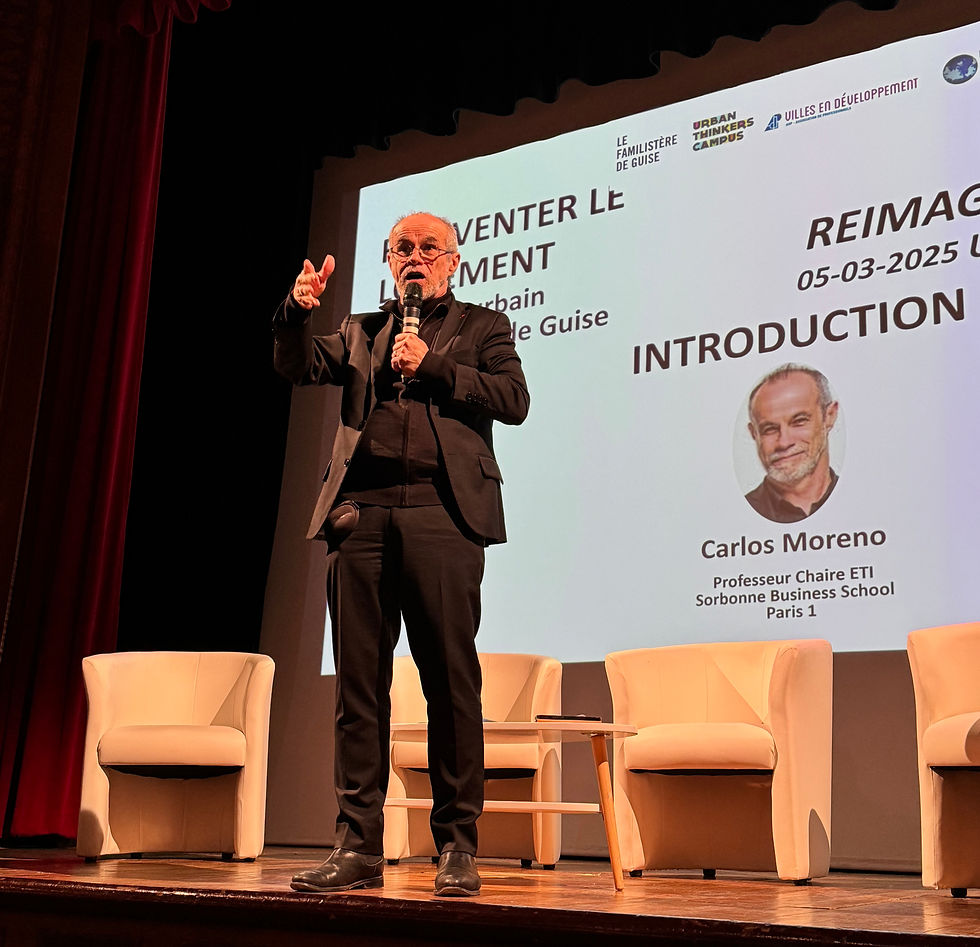
The afternoon began with a highly anticipated presentation by Carlos Moreno, professor at Sorbonne Business School, holder of the “Entrepreneuriat Territoire Innovation (ETI)” chair, and internationally recognized for the concept of the 15-minute city. He highlighted the structural link between housing, mobility, local services, and urban quality of life. For Carlos, revisiting the Familistère experience as a “social solution” leads us to reflect on the place of collective and social housing in our contemporary society. In France, 56% of housing is single-family homes, while social housing accounts for only 14% of the total. In addition, nearly 80% of household expenditure is devoted to housing, transportation, and basic services, leaving only a small portion for other essential needs. The pooling of basic service costs and the reduction in transportation costs offered by collective housing and the 15-minute city effectively increase the “disposable income.” This model thus invites us to go beyond the social utopia of the Familistère to envisage a new territorial unit based on social harmony and equitable access to urban resources.
This reflection opened up discussions on the conditions for a more humane and sustainable urban planning, where housing becomes a central lever for ecological, social, and economic transformation.

Three thematic sessions to shed light on the housing of tomorrow
The first session explored architectural and social innovations in housing. Moderated by Xavier Crépin, associate professor at Sciences Po Rennes (Master's in Urban Network Services Engineering: Cities in the Making) and founding member of AdP Villes en Développement, with speakers: Jean-Jacques Hubert, architect and co-founder of h2o architectes; Delphine Deleneuville, operations engineer at CDC Habitat, and Prudence Adjanohoun, Secretary General of the Réseau Habitat et Francophonie (RHF) and international project manager at the Union sociale pour l'habitat (USH). They shared concrete experiences of renovation, construction, and integration in social housing.
Delphine Deleneuville described the activities of CDC Habitat, a public-private operator that offers residential options ranging from social housing to private housing, with tailor-made solutions for its residents. Its territorial network enables it to intervene in a variety of cases and on different scales, from an intervention in the Olympic Games village to the energy renovation of its buildings.
In addition, CDC Habitat won the Call for Expressions of Interest for the renovation of the right wing of the Familistère, comprising 77 housing units. This project led to a debate on the challenge of moving from collective housing to a privatized space, while promoting community living.
Jean-Jacques Hubert presented two urban regeneration projects in dense urban areas, transforming public buildings into mixed-use buildings with offices and collective housing. The first project, the Reuilly barracks, involved the transformation of a former state barracks sold to the city and slated for demolition. The challenge was to work on the quality of the building to mitigate the original aesthetic appearance of the barracks and to work on the central space. With a total of 40,000 m² to be created, a project team was formed with six architects, who organized a series of workshops for the design. Finally, the Îlot Saint-Jean project focused on a building dating from the 18th and 20th centuries. The block initially contained 254 social housing units, to which 83 additional units were added, based on different plans.
Prudence Adjanohoun presented public housing policies from the perspective of social housing federations. He pointed out that current demographic and social changes mean that 450,000 new homes need to be built each year. France now has nearly 5 million social housing units, making it the leading European country in terms of volume. Social housing is also becoming a European issue, as evidenced by the appointment, for the first time, of a European commissioner dedicated to this issue.
The debate highlighted the importance of involving users from the project design phase onwards, and the need to move beyond strictly technical and financial approaches in favor of more humane, inclusive, and sustainable solutions.
The second session focused on the convergences and divergences of collective and participatory housing models at the international level. Moderated by Aziza Akhmouch, Director of the Cities, Urban Policy and Sustainable Development Division at the OECD Centre for Entrepreneurship, SMEs, Regions and Cities, and Nikolay Kolev, Consultant at the OECD, with speakers: Christophe Bartholeyns, Coordinator of the European NEB-LAB Eco²-Schools program, and Patricia Auroy, Partner at SCIC Alliance Sens & Économie and co-initiator of Microville 112. They illustrated how participatory approaches, the social economy, and local ecosystems are transforming the way we live.
Christophe Bartholeyns presented the Net-Lab project, which aims to transform a former military base into a micro-city. This conversion is based on a close alliance between local stakeholders and industrial companies, with a view to developing a holistic vision of local development. Five main areas of focus were identified, giving rise to collective discussions that gradually brought out the functions needed for the site. These were then translated into concrete actions through co-design workshops. This approach has already led to several tangible achievements: the construction of a school, the installation of an outdoor boiler room, and the implementation of collaborative housing projects.
The project highlights a new dynamic of empowerment in public policies for city building, in which companies themselves become actors in urban production, alongside local authorities. However, this raises the issue of fragmented governance. Furthermore, far from being a single model, collective housing comes in a variety of forms, adapted to different cultures and territorial contexts.
The final session opened a discussion on the links between housing, collaborative urban planning, and resilience in the Global South. Moderated by Christine Auclair, President of AdP - Villes en Développement, with speakers: Luc Gnacadja, President of GPS-Dev, former Minister of the Environment, Housing, and Urban Planning of Benin, and former Executive Secretary of the United Nations Convention to Combat Desertification (UNCCD); Anne Burlat, urban architect and consultant specializing in territorial and urban issues, with expertise in project support in inhabited contexts and crisis management; and Pierre Arnold, civil engineer and urban planner, currently project manager at urbaMonde-France.
They highlighted the importance of cross-cutting approaches to strengthening the resilience of housing and urban planning in the Global South. Housing is not an isolated issue, but part of an urban project that integrates services, mobility, governance, ecology, and memory.
Luc Gnacadja presented the current challenges of urbanization in Africa, where the urban population is expected to double by 2050[1]. Today, urban development is largely informal, while public authorities struggle to cope with the risks posed by rapid urban growth, a predominantly young population, and largely unplanned housing. It is therefore imperative to invest heavily in these areas to provide them with essential facilities and services. However, informal neighborhoods attract little investment due to a lack of recognition of their value and role in urban dynamics. This is all the more paradoxical given that the informal economy accounts for more than 80% of urban economic activity on the continent. It is essential to move beyond the opposition between formal and informal cities, promote inclusive densification, and strengthen cooperation between policy makers and urban managers.

Anne Burlat presented a number of projects illustrating the challenges and levers for action in informal housing situations, particularly in slums[2]. She emphasized the importance of acting at different levels: the needs of residents, housing or buildings, the neighborhood and urban form, and finally political support. In Nepal, following the earthquake, a vast reconstruction effort was launched with a massive influx of funding to develop earthquake-resistant housing. However, the government favored an approach focused solely on building renovation, without really taking into account the needs and expectations of residents. This technical response, disconnected from actual uses, led to the construction of neighborhoods that remained unoccupied in 2023. In Mayotte, several slums remain despite various housing policies that have been implemented. Their persistence shows the limitations of these policies in this overseas territory. The French government launched a call for tenders for the construction of housing, based on a traditional project management approach, but this only resulted in the delivery of a few dozen homes, while the estimated need is 2,000. These examples highlight the importance of taking local realities and social dynamics into account in order to design appropriate and effective housing policies.
Pierre Arnold presented the creation of a platform dedicated to participatory housing projects led by the residents themselves[3]. This platform lists numerous examples from around the world, demonstrating a genuine international movement.
It is supported by the World Habitat Awards, organized in partnership with UN-Habitat. Among the illustrative projects is one in Puerto Rico, where a group of residents carried out a development by filling in a watercourse. Today, around 20,000 people live there. In Senegal, groups of women have formed tontine associations to create collective financial capacity. This enabled them to design and build their own neighborhood, meeting their specific needs and their desire to live in a community. These initiatives demonstrate the ability of residents to become actors in their own living environment by mobilizing collective forms of mutual aid and governance. They echo the spirit of the Familistère de Guise, where housing was already conceived as a lever for collective emancipation and social transformation.
In conclusion, the session moderators shared the highlights of the day: the call for a renewed way of thinking about housing as a vehicle for social justice, community living, and civic experimentation. The Familistère, through its inspirational power, invites us to “live differently”: by drawing on local resources, recreating solidarity, and articulating memory and modernity.
Summary
Housing is at the heart of contemporary tensions: the affordability crisis, the deterioration of existing housing stock, urban sprawl, the isolation of residents, energy poverty, and more. Faced with these challenges, the Urban Campus event held on March 5, 2025, at the Familistère de Guise was a key moment of collective reflection, bringing together more than 80 participants from the fields of research, local government, urban planning, architecture, NGOs, and international institutions.
The venue itself is meaningful. The Familistère de Guise, designed and built by Jean-Baptiste André Godin in the 19th century, was not just a utopia: it was a concrete and audacious realization of a collective habitat based on dignity, proximity, and sharing. By revisiting this historical model, the organizers—the Syndicat Mixte du Familistère, AdP-Villes en Développement, and the OECD—sought to examine the forms of housing of today and tomorrow in light of this experience.
Among the powerful ideas shared during the day, Carlos Moreno's presentation made a lasting impression. He emphasized that the transformation of housing must be part of a broader vision of the polycentric city and local services, based on the principle of the “15-minute city.” This model is based on relocating urban functions to reduce distances, promote active mobility, and recreate social ties. From this perspective, housing becomes the anchor of a resilient and inclusive city, rather than simply a sectoral policy issue.
Luc Gnacadja's presentation introduced a decisive perspective from the Global South, emphasizing the centrality of informal housing in current urban dynamics, particularly in Africa. Faced with rapid urbanization, a predominantly young population, and limited public capacity, he reminded the audience that informality is not an anomaly to be corrected, but a structuring reality of the urban fabric. He called for recognition of the informal economy, which accounts for more than 80% of activity in many African cities, and for a paradigm shift: inclusive densification, investment in informal neighborhoods, and overcoming the opposition between formal and informal cities. This point of view broadened the debate beyond the European context, inviting a more global, supportive, and realistic reading of contemporary housing issues.
The discussions highlighted several converging trends:
· The need to rethink housing as a social living space with an ecological impact.
· The rise of participatory approaches, where residents become actors in their own housing.
· The need to integrate housing, services, nature, and mobility into local projects on a human scale.
· The importance of drawing inspiration from the concrete utopias of the past to invent solutions adapted to the challenges of the 21st century.
The role of design, architecture, and urban development has emerged as essential, as has cross-disciplinary collaboration between different fields, stakeholders, and scales.
Far from being a static museum, the Familistère has become a platform for dialogue and experimentation. In a global context of uncertainty, this day embodied a form of optimistic lucidity: one that allows us to dream while taking action, anchoring innovation in memory and territories.
At a time when public housing policies are seeking a second wind, this initiative highlights how inspiring places can fuel ambitious collective thinking.
Through its mission to connect urban professionals, AdP reaffirms its vocation: to circulate ideas, practices, and experiences so that cities and their inhabitants can together find paths to a more just and sustainable future.
[1] See the full presentation and Luc Gnacadja's article on the topic: What if the real challenge of housing in Africa were not financing? (Bulletin Villes en Développement #118)
[2] See Anne Burlat's full presentation
[3] See Pierre Arnold's full presentation and article on the theme: The city by and for its inhabitants. Land management, self-build, solidarity-based financing (Bulletin Villes en Développement #118)
This English translation was prepared with the assistance of DeepL, a language model developed by OpenAI, based on the original French article published in May 2025 on the AdP – Villes en Développement bulletin website.


Comments