Coastal Mobility Systems Under Climate Change Pressure: Towards Adaptive Vulnerability Management
Aurélie JEHANNO, Associate Lecturer, Sciences Po Rennes
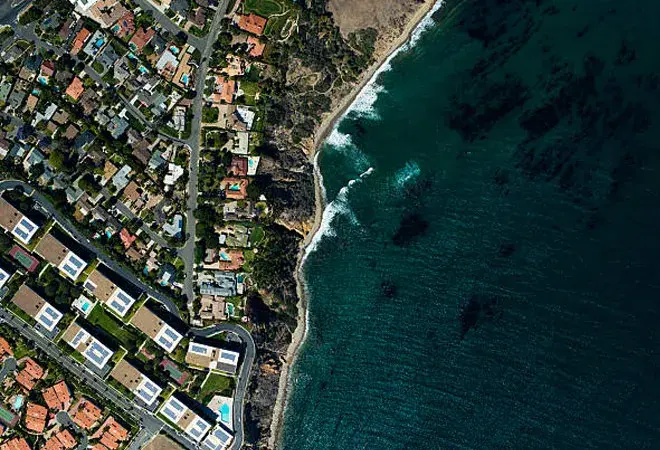
Coastalisation is now one of the major forces reshaping urban mobility systems. In 2018, nearly one-third of the world's population lived within 20 kilometres of the coastline. By concentrating populations, economic activities and infrastructure along coastal zones, this trend places transport networks on the front line of climate-related hazards.
The case of Agbodrafo, located 35 kilometres from Lomé, provides a striking illustration. There, the sea has already swallowed three paved roads as well as a cemetery, and the coastal road itself has had to be relocated inland on three separate occasions.¹

Today, the challenge is no longer simply to protect infrastructure, but also to organise mobility systems that are compatible with dynamic, unstable and highly exposed environments.
This article first proposes a functional approach to vulnerability, focusing on service continuity and the identification of critical links within transport networks. It then draws on a range of case studies to highlight the limitations of purely infrastructure-based responses. Finally, it presents a spectrum of solutions combining engineered structures, adaptive planning measures and nature-based solutions.
Coastalisation, Concentration of Flows and Functional Vulnerabilities
In many coastal cities of the Global South, transport infrastructure does more than accompany urban and economic development: it actively shapes it. By concentrating flows, jobs and investments along a limited number of major corridors, transport networks have a lasting influence on the spatial organisation of territories. The more effectively a corridor connects a port to its hinterland, the more economic activity it attracts. However, this centrality comes at a cost: any disruption to the infrastructure can quickly generate significant social and economic consequences.
For this reason, vulnerability should be assessed through the functions performed by the network. The key questions are which connections must remain operational, which uses should be prioritised, and which users would be most severely affected in the event of disruption. From this perspective, an approach centred on continuity of use is more relevant than a simple mapping of exposed areas. The ASAIT methodology developed by Cerema is fully aligned with this logic. It provides an operational framework for analysing hazards, identifying critical network components and defining expected levels of service.³
Coastal Corridors and Systemic Dependency
This dynamic is particularly evident in major transport corridors. The Abidjan–Lagos Highway project, stretching nearly 1,000 kilometres, is emblematic of this tension. Linking five coastal metropolitan areas—Abidjan, Accra, Lomé, Cotonou and Lagos—it supports exchanges between ports, logistics hubs and urban markets. At the same time, however, it concentrates dependency on a limited number of critical links.
A corridor of this scale is more than a line on a map: it is a system infrastructure. If a bridge, embankment or coastal section is disrupted by flooding, shoreline erosion or structural degradation, the continuity of trade and mobility across the entire corridor can be compromised. Regional integration thus becomes, paradoxically, a source of systemic vulnerability. This underlines the need for route redundancy, secondary connections and diversion strategies to be planned in advance.
The Limits of Hard Protection Measures
Large-scale protective structures provide responses to situations of acute exposure, but they also reveal their limitations when they become the dominant strategy. As climate hazards intensify, such measures can lock territories into rigid development pathways, shift risks elsewhere and increase dependence on heavy infrastructure that is costly, complex and difficult to maintain over time.
Jakarta and Its Giant Sea Wall
Jakarta provides a particularly revealing example of the logic behind large-scale engineering solutions and their limitations. Indonesia’s capital faces a combination of rapid land subsidence, sea-level rise, intense urban pressures and increasing exposure to flooding. Following the devastating floods of 2007, the Giant Sea Wall project was officially launched in 2014, with the inauguration of an initial 8-kilometre section. In some parts of the city, land subsidence reaches as much as 25 centimetres per year, while approximately 40 per cent of the territory already lies below sea level.
Designed as a large-scale protection system, this 32-kilometre structure, ultimately linked to the development of 17 artificial islands, nevertheless illustrates the limitations of a predominantly infrastructure-based response. While it protects certain areas, it also locks in development choices, may transfer risks to other locations and creates long-term dependence on infrastructure that is costly and complex to maintain.
Ho Chi Minh City and the Hydraulic Crisis
In Ho Chi Minh City, vulnerability takes a more diffuse yet equally structural form. The Asian Development Bank’s report on the city’s adaptation to climate change indicates that, in the absence of a flood control plan, 67 per cent of industrial land could be inundated during an extreme event.⁴ The same report highlights the significant exposure of road infrastructure to flooding by 2050, with expected disruptions to commuting patterns and the transportation of goods to ports and industrial zones.
As a result, what begins as a drainage crisis becomes a crisis of everyday mobility, industrial accessibility and service continuity.
Lock-in Effects and Structural Trade-offs
These technical limitations help explain why some countries are pursuing more radical policy choices. Indonesia, for example, has decided to gradually relocate key governmental functions from Jakarta to Nusantara, with an announced investment of approximately USD 34 billion.⁵ This decision does not eliminate risk; rather, it redistributes it and signals that beyond a certain threshold of vulnerability, local protection measures alone are no longer sufficient.
Relocation thus becomes the symptom of a system that has reached the limits of its development model. Yet the challenge is not to choose between “large-scale protection” and “relocation”. Instead, it is to combine engineering, spatial planning and governance within a framework of adaptive management.
Nature-Based Solutions for Enhancing Territorial Resilience
Nature-based solutions do not replace protective infrastructure, but they can enhance its performance and reduce lock-in effects. In this article, the term green infrastructure is used in a closely related sense, referring to planning and design interventions that harness the ecological functions of natural systems to strengthen territorial resilience. The two concepts largely overlap, although the former places greater emphasis on ecological processes, while the latter focuses on their integration into spatial planning and infrastructure development.
Proven Economic Benefits
In the Mekong Delta, Oanh, Tamura, Kumano and Nguyen demonstrate through a cost-benefit analysis that, in the absence of adaptation measures, more than 90 per cent of the delta area could fall below sea level by 2100, exposing between 10 and 19 million people and generating cumulative damages estimated at between USD 4.5 trillion and USD 17.2 trillion.⁶ By contrast, a hybrid strategy combining four-metre dikes with mangrove belts dramatically reduces damages, for total estimated costs ranging from USD 12 to 19 billion.
A report by the World Bank Group and the Global Facility for Disaster Reduction and Recovery (GFDRR) confirms these findings at a broader scale. Mangroves are estimated to prevent an average of USD 65 billion in damages each year, while coral reefs avoid approximately USD 4 billion annually. The benefit-cost ratios of coastal protection investments frequently exceed 5 to 1.⁷ In urban environments, stormwater retention systems and peak-flow reduction measures have also demonstrated positive net economic returns.
Persistent Institutional Barriers
Despite these encouraging results, scaling up nature-based solutions remains challenging. The barriers are not solely financial; they are also institutional. Many project owners and infrastructure agencies remain more comfortable with conventional civil engineering solutions, which are often perceived as more predictable, more standardised and easier to procure and contract.
Green infrastructure, by contrast, requires land-use arrangements, long-term governance mechanisms and innovative economic models capable of sustaining maintenance over time. Its widespread deployment therefore calls not only for an evolution of project delivery tools, but also for a transformation of decision-making frameworks, financing mechanisms and maintenance practices.
Adaptive Management and Hybrid Solutions
Green Corridors and Urban Nature
The green corridor project currently underway in Dakar provides an interesting example of an integrated approach. It combines active mobility, urban greening and improved stormwater management to make travel safer and more resilient.⁸ On the campus of Cheikh Anta Diop University, the initiative brings together a bicycle-sharing service, landscape improvements and a participatory approach that actively involves vulnerable groups. In Bogotá, green corridors similarly combine vegetation, enhanced public spaces and sustainable mobility.
These examples demonstrate that a transport corridor can become an ecological infrastructure, improving user comfort and safety while increasing the capacity to absorb and manage stormwater.
Hydraulic Connectivity: Maintaining Natural Water Flows
Road and railway embankments can act as barriers when they interrupt natural water flows. Ensuring hydraulic connectivity involves incorporating hydraulic openings—such as culverts, channels and short-span bridges—that allow water to circulate freely. This issue is particularly critical for coastal and lagoon embankments, which can exacerbate upstream flooding if they remain impermeable to water movement.
Between Arles and Tarascon in southern France, the reinforcement of a railway embankment was designed in conjunction with a flood expansion area, demonstrating that hydraulic connectivity can be integrated into railway infrastructure without compromising its protective function.⁹ From this perspective, hydraulic connectivity and functional redundancy become design criteria that are just as important as structural strength.
Governance and Spatial Justice
In many cities of the Global South, redeveloped waterfronts tend to attract investment and the most valued forms of mobility, while lower-income populations, informal activities and more traditional forms of transport are pushed towards areas that are more exposed to environmental risks. Transport systems can either reduce or reinforce these inequalities depending on investment priorities, pricing policies and the continuity of services maintained during times of crisis.⁸
A robust adaptation strategy must therefore address a fundamental set of questions: Who is protected? Who benefits from large-scale infrastructure investments? Who bears the costs of adaptation? And who remains exposed to residual risks? Without such considerations, resilience risks becoming a purely technical objective disconnected from social realities.
From Theory to Practice: Principles for Implementation
A resilient infrastructure is not merely one that withstands shocks; it is one that can evolve alongside its environment. In practical terms, this means treating shorelines and flood levels as dynamic rather than fixed parameters, planning for degraded levels of service, anticipating modal substitutions and recognising maintenance as a strategic function.
It also means designing redundancy into networks, testing contingency measures, combining targeted protective infrastructure with nature-based solutions, and establishing long-term governance arrangements capable of ensuring sustainable maintenance and adaptation over time.
Conclusion
Protecting without adapting creates vulnerability; adapting without protecting increases exposure. Building resilience in coastal mobility systems therefore requires responses that are integrated, adaptive and equitable, capable of maintaining essential functions through a functional and iterative approach. This represents a major challenge for infrastructure owners, operators and their advisors.
Beyond technical choices, such a shift also calls for a transformation of governance practices and financing models. The real challenge is not simply to fund individual infrastructure projects, but to develop long-term investment and maintenance frameworks capable of supporting the continuous adaptation of coastal mobility systems.
This requires fully accounting for maintenance costs, the need for network redundancy, the avoided costs generated by preventive action, and the value of nature-based solutions in budgetary decision-making. Ultimately, resilience depends not only on what is built, but on the capacity to sustain, adapt and manage infrastructure over time in response to changing environmental conditions.
This article has been translated using ai.
References
Africa Press. “Coastal Erosion: How Togo Is Paying the Price.” Available at: https://www.africa-press.net/togo/dossiers/erosion-cotiere-comment-le-togo-paie-la-note
Based on World Bank data (2019) and the West Africa Coastal Areas Management Program (WACA). Available at: https://www.worldbank.org/en/programs/west-africa-coastal-areas-management-program
Cerema. Infrastructure Resilience. Factsheet No. 2: Ten Steps to Improve the Resilience of Your Transport Infrastructure. Systemic Approach to Transport Infrastructure Adaptation (ASAIT). Cerema Editions, 2024.
Asian Development Bank. Ho Chi Minh City Adaptation to Climate Change: Summary Report. Available at: https://www.adb.org/sites/default/files/publication/27505/hcmc-climate-change-summary.pdf
Sciences et Avenir. “Jakarta Is Sinking: Why Not Relocate It?” 10 May 2019.
Pham Thi Oanh, M. Tamura, N. Kumano and Q. V. Nguyen. “Cost-Benefit Analysis of Mixing Gray and Green Infrastructures to Adapt to Sea Level Rise in the Vietnamese Mekong River Delta.” Sustainability, Vol. 12, 2020.
World Bank Group and Global Facility for Disaster Reduction and Recovery (GFDRR). Assessing the Benefits and Costs of Nature-Based Solutions for Climate. 2023.
Deutsche Gesellschaft für Internationale Zusammenarbeit (GIZ). Promoting Active Mobility in Senegal. Available at: https://www.giz.de/en/projects/promouvoir-la-mobilite-active-au-senegal
SYMADREM. Project Documentation for the Dike Construction between Tarascon and Arles. 2022; SYSTRA. Enhancing Hydraulic Connectivity of the Railway Embankment between Tarascon and Arles. 2022.


Comments